
What if feeling stuck doesn’t mean you need to have all the answers before you begin? Personal growth coaching can offer space to notice what feels out of step, explore what matters to you and choose one manageable next step. You don’t need a perfect description of what’s wrong to start reflecting.
It’s understandable to wonder whether coaching will feel supportive and practical, or whether it’s right for you. It isn’t a promise of instant clarity or guaranteed change. Instead, it can give you room to reflect, look at a question from different angles and decide what you want to do next.
This guide explores what personal growth coaching may involve, how to approach it thoughtfully and how broad hopes can take shape as gentle, achievable actions. You’ll also find guidance on Emma’s therapies, coaching and My Empty Bowl Grounding technique, including how the grounding technique can accompany reflection. Take what feels useful, and let the next step be small.
Key Takeaways
- Personal growth coaching can help you explore what matters and consider possible next steps, even if you don’t have a clear goal yet.
- A practical path from reflection towards change is to notice what matters, explore different perspectives, consider your options and choose one small step.
- To prepare, pause, name what feels present, consider what matters to you and choose a question. You don’t need to arrive with a solution.
- Readiness may simply mean being willing to reflect and consider a next step. Suitability is personal, not a checklist.
- Emma’s therapies and coaching provide practical guidance and supportive mindfulness techniques. My Empty Bowl can accompany grounding and reflection.
What is personal growth coaching, and what might it help you explore?
You don’t need to reach a crisis point or arrive with a polished plan before wanting something to change. Perhaps a familiar routine no longer feels right, or you sense there’s a question you haven’t had room to sit with. That feeling can be worth noticing in its own right. You don’t have to justify it by pointing to something being wrong.
Personal growth coaching is a collaborative space for reflection, gaining perspective and considering possible next steps in response to what matters to you. It isn’t about being handed a life plan. Conversation can help you examine your hopes, concerns and choices, then decide what, if anything, you’d like to explore further.
Growth doesn’t have to mean fixing yourself. It can mean understanding your needs more clearly and making choices in line with your values, rather than trying to meet somebody else’s idea of success. Personal development takes different forms, from self-directed learning to coaching; the Personal Development Overview offers a broader introduction to these approaches.
What kinds of personal questions can coaching make space for?
The starting point might be a feeling, not a formal goal. You could feel stuck in a routine, be facing an unexpected change or want greater clarity about what you want next. Perhaps you’re asking, “What feels important to me now?” or “What small choice could make this week feel more like my own?”
These are examples, not signs that coaching is necessary. Some questions settle through time, personal reflection or a conversation with someone you trust. Coaching offers a structured, collaborative setting to explore a question when that feels useful to you.
What personal growth coaching is, and isn’t
Coaching can support reflection and practical exploration, helping you consider different perspectives and possible actions. It doesn’t guarantee transformation, a particular answer or a smooth path forward. You decide what fits, what doesn’t and whether to take a next step.
It also isn’t a measure of your worth or proof that you need to become someone different. Different forms of support suit different needs and circumstances. Coaching and therapy are distinct forms of support. The useful question is what kind of support feels appropriate for what you’re carrying now.
There’s no need to turn an uncertain feeling into a grand ambition before you can begin reflecting. A quiet question can be enough: what would I like to understand a little better? You can take your time, notice what comes into view and decide whether further support feels helpful.
How personal growth coaching can move from reflection towards change
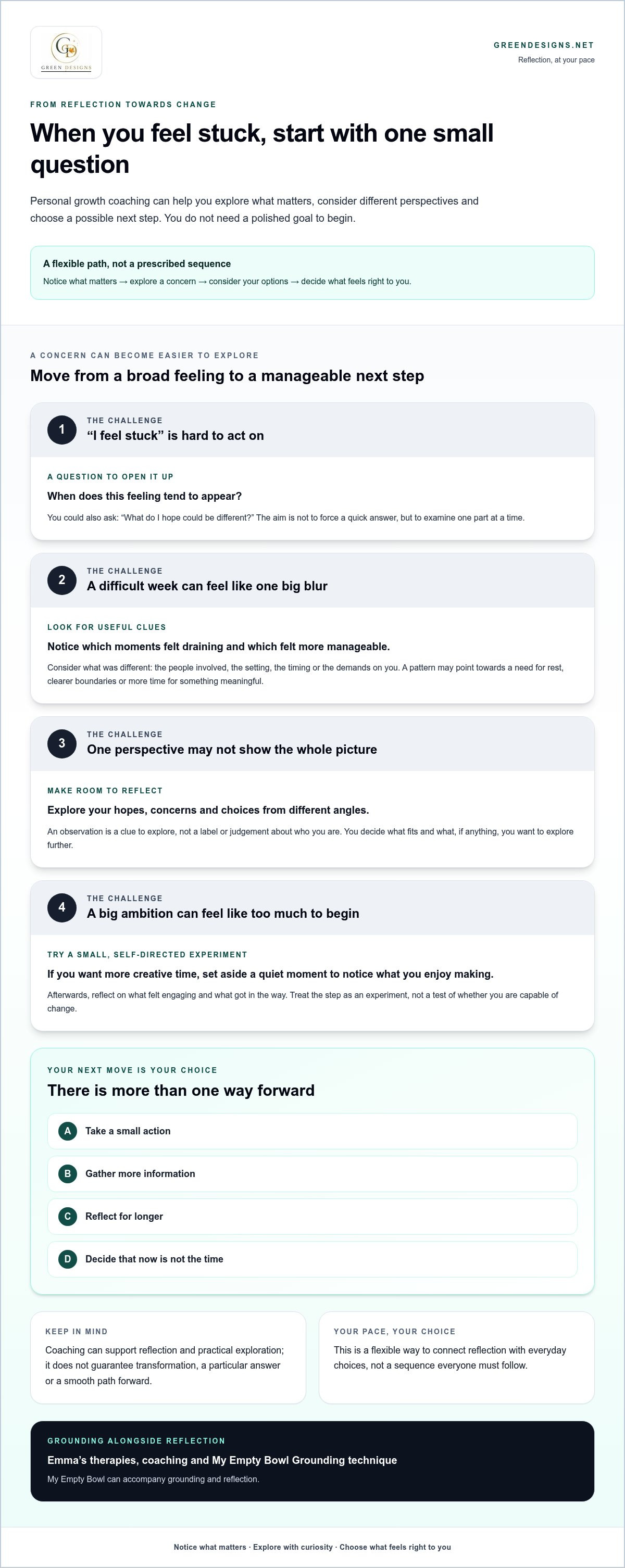
Insight doesn’t have to arrive as a sudden revelation. Often, it gathers gradually: you notice what matters, look at a concern from another angle, consider a few options and decide whether one small step feels worth trying. This is a flexible way to understand how personal growth coaching may connect reflection with everyday choices, not a prescribed sequence everyone must follow.
Coaching can support reflection and help you consider possibilities, whilst the choices and pace remain your own. Looking back at an experience may help you notice a recurring situation, an unmet need or a value you want to honour. These observations aren’t labels or judgements about who you are. They’re clues to explore with curiosity.
For example, after a demanding week, you might note which moments felt draining and which felt more manageable. Ask what was different about those moments: the people involved, the setting, the timing or the demands on you. A pattern might point towards a need for rest, clearer boundaries or more time for something meaningful. It doesn’t dictate what you should do; it gives you more context for making a choice.
From a broad concern to a question worth exploring
“I feel stuck” can be a starting point, not a problem to solve on the spot. You might ask, “When does this feeling tend to appear?” or “What do I hope could be different?” The aim isn’t to force a quick answer. It’s to make the concern easier to examine, one part at a time.
Uncertainty doesn’t mean you lack motivation. You may simply need room to understand what the feeling is connected to before deciding what comes next. Notice whether it arises around a particular responsibility, relationship or daily routine. That detail can make a broad concern easier to explore.
Turning insight into a small, self-directed next step
Once something feels clearer, a modest action can help you explore an aspiration in daily life. If you’re longing for more creative time, for instance, you could set aside a quiet moment to notice what you enjoy making, without turning it into a large commitment. Afterwards, reflect on what felt engaging and what got in the way. Treat the step as an experiment, not a test of whether you’re capable of change.
Some general coaching frameworks, such as GROW, use questions about a goal, the current reality, possible options and a way forward. This is one example of a reflective structure, not a stated method used in Emma’s sessions. Any framework is useful only if it leaves room for your circumstances, preferences and pace.
A next step could be to act, gather more information, reflect for longer or decide that now isn’t the time. Each is a choice. Emma’s therapies and coaching provide practical guidance and supportive mindfulness techniques to help you explore your own questions. You can learn more about Emma’s therapies and coaching.
Is personal growth coaching right for you? A thoughtful way to consider fit
There’s no single sign that tells you coaching is the right choice. A recurring concern, a period of change or a wish to understand yourself better might prompt you to consider it, but none means you need coaching. Fit is personal. Start by noticing whether you feel willing to pause, reflect and explore what could be helpful, without needing to commit to a particular outcome.
You don’t have to arrive with a polished goal or a clear plan. Perhaps you’re curious about why a certain choice feels difficult, or what you want more space for. That can be enough to begin exploring. Equally, another form of support, or no additional support for now, may feel more fitting.
Signs you may be ready to explore personal growth coaching
Rather than looking for a checklist, sit with a few open questions. Is there a concern you keep returning to? What would you like to be different, even if you can’t yet picture how? What would you value having space to examine? You can be curious without knowing the answer. No single feeling or life event proves that coaching is needed.
Questions to hold alongside your expectations
Consider what supportive guidance would feel like for you. Would you value time to think aloud, a practical perspective or gentle questions that help you organise your thoughts? Your preferences may become clearer as you reflect. Coaching can offer space to explore, but it can’t guarantee change; any decisions and their pace remain personal.
It may also help to ask what you hope support will provide, and whether that hope feels realistic. You might want clarity, while leaving room for reflection to bring up further questions rather than a neat answer. A useful experience doesn’t have to produce a dramatic turning point. Sometimes it’s enough to understand a concern in a new way or see one choice more clearly.
Coaching isn’t the only kind of support available, and different approaches may suit different needs and circumstances. If you’re weighing up coaching alongside therapy, the article on private therapy and coaching offers a fuller comparison. You don’t need to pass a test before taking a next step. Take time to consider what feels appropriate, revisit the question later or choose a form of support that better reflects what you need.
For now, readiness can be as simple as a willingness to be honest with yourself about what you’d like to explore. You don’t need certainty, a crisis or a perfectly worded goal. A little openness may be enough to begin deciding whether personal growth coaching feels useful to you.
How to prepare for personal growth coaching without forcing a perfect goal
Preparing for personal growth coaching doesn’t mean arriving with a polished goal, a timeline or a solution. A little reflection may help you gather your thoughts, but it’s optional. You can begin with uncertainty, a feeling you can’t quite name or simply a wish to see what comes up in conversation.
Pause, notice what feels present, consider what matters to you and choose one open question to carry into the conversation. These steps are an invitation, not a formula for a particular result. You can take them in your own way, leave some aside or arrive without having prepared at all.
A simple reflection before a coaching conversation
If it feels useful, take a quiet moment to notice what has been occupying your attention lately. Jot down a phrase or two, or let the thought settle. Try observing what you feel without judging it or needing to resolve it straight away. The aim is not to make a case for change, but to meet your experience with a little more care.
Then consider what you’d like more space, clarity or choice around. An open question can make room for discovery without demanding a quick answer. For instance: “What would I like to understand about this?” or “Where might I want a little more choice?” You don’t need to turn the question into a target or attach a deadline. Let it remain a starting point.
You could use four gentle prompts:
- Pause. Settle for a moment before trying to work anything out.
- Name what feels present. Notice a thought, feeling or concern without labelling yourself.
- Consider what matters. Ask what value, need or hope might sit beneath it.
- Choose a question. Carry one thing you’re curious about, rather than a demand for a perfect answer.
Using grounding to arrive with a little more presence
Grounding is a way of bringing attention back to the present moment. You might notice your feet resting on the floor, the feel of a chair beneath you or the sounds around you. There’s no need to make anything happen; simply observe what’s here now.
A mindfulness practice may offer a supportive pause before reflection, particularly if your thoughts feel busy. Keep it simple, and stop if it doesn’t feel helpful. Grounding practices can be gentle ways to reconnect with the present, not guaranteed solutions or replacements for other support you may need.
Emma’s therapies and coaching offer a thoughtful space to explore what matters to you, with practical guidance and supportive mindfulness techniques. You can use this support to reflect on your questions without needing to have everything figured out first.
Emma’s therapies, coaching and My Empty Bowl Grounding technique
Once you’ve had a little space to consider what matters to you, tailored support can be one possible next step. Emma offers one-to-one therapies and coaching, shaped around the individual. For someone exploring personal growth coaching, this means having a setting for reflection alongside practical guidance and supportive mindfulness techniques, without needing to arrive with a complete plan.
Tailored support for personal obstacles and emotional wellbeing
Everyone brings different circumstances, questions and hopes. Emma’s one-to-one therapies and coaching are tailored to the person, with practical guidance and supportive mindfulness techniques. This offers a way to explore what feels relevant to you, rather than follow a one-size-fits-all script. You can begin with what’s on your mind and take time to notice what feels useful to consider.
Support doesn’t need to be framed as fixing a flaw or reaching a particular milestone. It can make room to reflect on an obstacle, understand what matters in your situation and consider possible choices. The pace and meaning of that exploration belong to you; there are no guaranteed outcomes or single correct answers.
Emma’s therapies and coaching are distinct forms of support, and what feels suitable will depend on your needs and circumstances. Tailored guidance can sit alongside your own reflection without taking choice away from you. You decide what you want to explore and whether a particular next step feels right.
My Empty Bowl as a companion to grounding and contemplation
My Empty Bowl is a mindfulness and contemplation tool developed to support grounding rituals. A grounding practice can offer a moment to return your attention to the present, creating a gentle pause before or during reflection. The My Empty Bowl Grounding technique can be part of that intentional practice.
It doesn’t promise a particular feeling or result, and it doesn’t replace coaching or other support. Rather, My Empty Bowl can sit alongside reflection as a grounding and contemplation tool. It can become one part of a personal ritual, with meaning shaped by your own experience.
There’s no need to decide everything at once. You might continue reflecting independently, explore a mindfulness practice or consider Emma’s therapies and coaching as a supportive space. My Empty Bowl can also be used as part of your grounding ritual. Let curiosity guide you and choose what feels appropriate for you.
Let your next step be your own
You don’t have to turn reflection into a plan straight away. Sometimes the next useful step is simply to carry one honest question into the days ahead and notice what it brings into focus. That gives your hopes room to take shape at a pace that feels like yours.
If personal growth coaching feels like a supportive way to explore what comes next, explore Emma’s therapies, coaching and My Empty Bowl Grounding technique. You don’t need to arrive with certainty or expect a particular outcome. Let your curiosity guide you and choose the kind of support that feels right for you.
Meaningful change can begin quietly, with a little space to listen to yourself. One small, considered step is enough for now.
Frequently Asked Questions
What is personal growth coaching?
Personal growth coaching is a collaborative conversation focused on your reflections, priorities and possible choices. You bring the subjects that feel relevant, and decide which ideas, if any, you want to take further. For example, you might explore how a change in routine sits with your values, rather than asking someone else to decide what your life should look like.
Can personal growth coaching help if I do not have a specific goal?
Yes, you can explore personal growth coaching without arriving with a precise goal. You might begin with a broad observation, such as feeling restless on Sunday evenings or unsure about a decision, then use conversation to understand what you’d like to examine. Curiosity is a valid starting point. Let a clearer focus emerge over time, or decide that you’d rather simply reflect for now.
How is personal growth coaching different from therapy?
Coaching generally centres on reflection, personal priorities and exploring possible ways forward, whilst therapy offers therapeutic support for emotional wellbeing. The approaches can differ in purpose and practice, and what feels appropriate depends on your circumstances and the support you’re seeking. Emma offers both therapies and coaching, so consider what you want from support rather than assuming one approach suits everyone.
How long does personal growth coaching take?
There isn’t one set timescale that applies to everyone. The amount of support someone wants may depend on the subject they’re exploring, their circumstances and what feels useful as they go along. You might be reflecting on a particular decision or taking time to understand a broader pattern in your life. Think about what you hope to explore without treating progress as a race.
What happens if I feel stuck during personal growth coaching?
Feeling stuck can be something to bring into the conversation, rather than a sign that you’ve failed. You might describe what feels difficult, revisit what you hoped to understand or notice whether the question itself needs to change. There’s no requirement to produce an answer on demand. A pause, a different perspective or simply naming what feels unclear can give you fresh material to consider.
Can mindfulness or grounding be part of personal growth coaching?
Mindfulness techniques can offer a supportive pause around reflection. Emma’s therapies and coaching include supportive mindfulness techniques, and My Empty Bowl is a contemplation tool intended to support grounding and daily ritual. These practices can accompany reflection and make space to notice what’s on your mind. They don’t guarantee a result or replace coaching; their place depends on what feels comfortable and relevant to you.