
What if you didn’t need to arrive with the right words, or know exactly what you wanted to change, to begin exploring support? The thought of one to one therapy can bring both hope and hesitation, especially when sharing personal thoughts with someone new feels daunting.
You may be wondering what happens in an individual session, or whether a group setting or a self-guided practice might feel more comfortable. There’s no single right way to seek support. A useful starting point is to think about what feels manageable: a private conversation, shared participation, or space to explore independently.
This guide explains what one-to-one support can involve, how it differs from group and self-guided options, and what to consider when deciding what might suit you. It also introduces Emma’s therapies, coaching and My Empty Bowl Grounding technique as ways to explore personal growth and mindfulness. You can use the practical questions below to identify what you hope for, without needing to make a decision before you’re ready.
Key Takeaways
- One to one therapy offers space to focus on your concerns, priorities and circumstances.
- Compare individual, group and self-guided support by considering the interaction and structure that feel comfortable.
- Start by naming what feels difficult and what you hope support might help you explore; you don’t need to have everything worked out.
- Emma’s therapies, coaching and My Empty Bowl Grounding technique bring together tailored guidance and mindfulness practice.
- Consider one manageable next step, such as writing down a question or exploring how individual support works.
What is one-to-one therapy, and when might individual support appeal?
One-to-one therapy is individual support centred on one person’s experiences, concerns and priorities, rather than a conversation shared with a group. It gives you a dedicated space to talk, reflect and explore what feels important. You don’t need to arrive with a diagnosis, a clear goal or a carefully prepared explanation. “I’m not sure where to start” can be a useful place to begin.
People may consider support during a period of change, when emotions feel difficult to understand, or because they want time for personal reflection. Therapy is a process of exploration, not a promise of a particular result. The focus can develop through conversation as you notice what feels useful to bring into the space. For a broader overview of the field and its approaches, Psychotherapy provides further background.
What makes one-to-one support different?
In an individual session, the conversation is centred on your life and the concerns you choose to raise. You might explore a recent situation, a feeling that keeps returning, or a question you’ve been carrying quietly. There’s room to pause, find the words gradually and follow a subject that feels relevant to you.
Unlike a group format, you don’t need to take turns or weigh your experience against other people’s stories. That can suit someone who prefers a private conversation, though it doesn’t make individual support more effective or suitable for everyone. The difference is the format: individual sessions focus on your circumstances, while groups bring shared participation and other perspectives.
What might lead someone to explore therapy?
There isn’t one threshold for seeking support. You might feel stuck over a decision, find that a change in your life is taking time to settle, or want to understand a recurring reaction. Perhaps nothing feels dramatically wrong, but you’d value time to listen to yourself without rushing towards an answer.
You don’t need to explain everything perfectly before exploring what support could look like. Notice what has been taking up space in your thoughts, what you’d like to feel more able to do, or what kind of conversation would feel comfortable. For example, you might write down one situation you keep revisiting and what you would like to understand about it. These observations can help you decide whether individual support appeals, without turning them into a test you must pass.
For some people, this exploration may connect with private therapy and coaching. Emma’s therapies, coaching and My Empty Bowl Grounding technique bring together tailored individual guidance and a mindfulness practice. You can begin by getting curious about what you’re hoping for, even if the answer is still taking shape.
How can one-to-one therapy create space for personal exploration?
Individual support centres your experiences and aims, giving you space to explore what feels important in a way that reflects your priorities. You can bring a concern, a question or even a feeling that’s difficult to name. The conversation can start with what’s most present for you and unfold from there.
A concern may seem small at first: a decision you keep putting off, a conversation that lingers in your mind, or a sense that you’re repeating a pattern without understanding why. Talking it through may help you notice what you feel, what matters to you and what you’d like to consider next. This is an opportunity for reflection, not a guarantee of a particular clinical outcome.
Making room for personal concerns
You can share at a pace that feels manageable. If a subject feels difficult to approach directly, you might begin around its edges, with what’s happening day to day or what you hope could feel different. There’s no need to have the whole story ready before you speak.
Your priorities can guide what receives attention. You may want to stay with one immediate worry, or find that another concern comes into view as you talk. The focus can shift as your thoughts become clearer; there’s no need to make every conversation follow the same shape.
Where grounding practices may sit alongside support
Grounding practices can offer a way to bring attention back to the present moment. You might pause to notice what’s around you or how your body feels, creating a moment to observe what is happening rather than immediately trying to solve it. These practices can sit alongside personal support as invitations to notice and reflect, not as a promise of treatment or a specific result.
Emma’s My Empty Bowl Grounding technique is a mindfulness-based practice that can support present-moment awareness. My Empty Bowl offers a practical point of focus as you explore your thoughts and feelings. Each person’s experience is different, so the technique is best understood as a supportive practice, not a guaranteed outcome.
If you’re considering beginning, think about what you might want to bring into a first conversation. A question, a few notes or a simple sense of what’s on your mind can help you get started. You don’t need to prepare a polished account.
When you feel ready to explore personal support, you can learn more about Emma’s individual support. Take your time and approach the possibility with curiosity rather than pressure.
Comparing one-to-one, group, and self-guided therapy
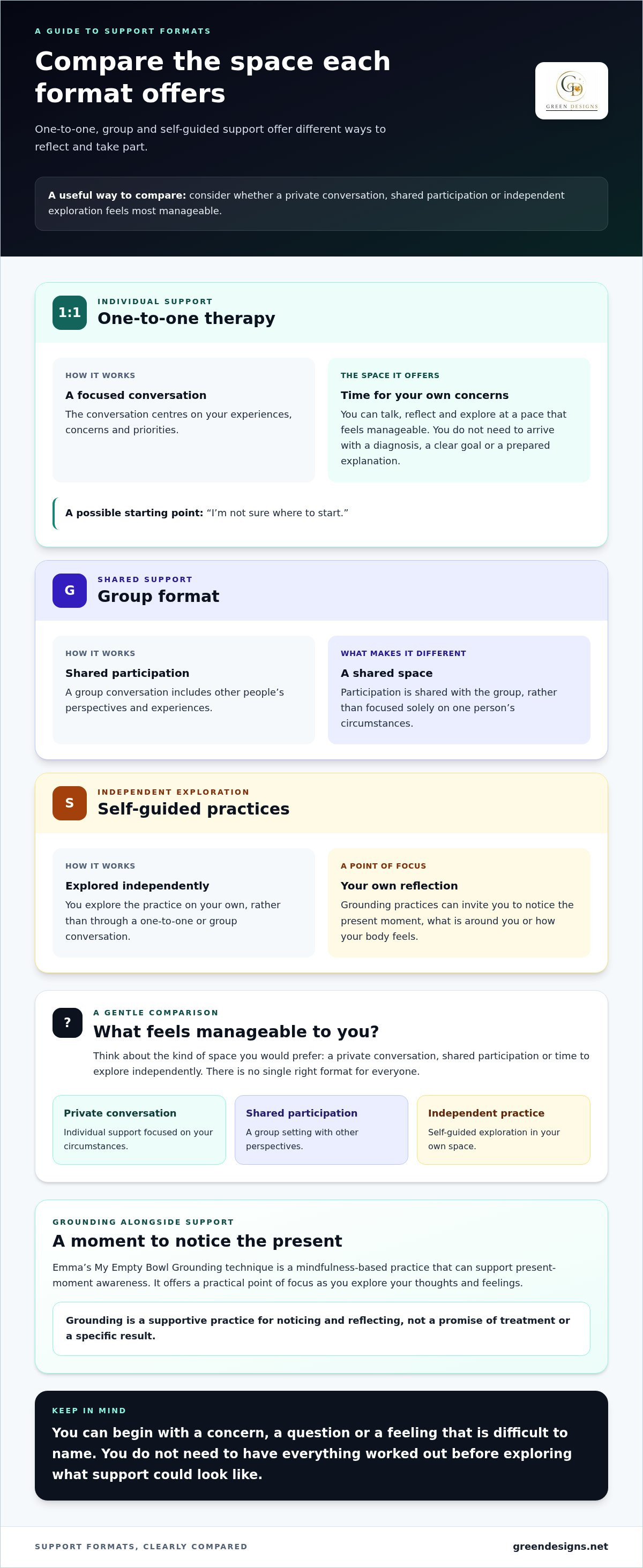
Different forms of support create different kinds of space. One to one therapy offers a focused conversation centred on your circumstances; a group brings shared participation and other people’s perspectives; self-guided practices are explored independently. None is automatically the right choice for everyone. Consider how much interaction you want, whether you prefer a personal focus, and how much structure feels helpful.
| Format | Interaction | Personal focus | Structure |
|---|---|---|---|
| Individual sessions | Conversation between you and a practitioner | Centred on your experiences and priorities | May adapt around what you bring |
| Group support | Shared participation with others | Personal reflection alongside group perspectives | May follow a shared topic or format |
| Self-guided practices | Independent exploration | Shaped by what you choose to focus on | May follow a resource or your own routine |
When individual support may feel like a better fit
You might prefer an individual conversation if you’d value more room to discuss personal circumstances or don’t want to share your reflections with a group. That preference doesn’t mean therapy is necessary, or that another format would be unsuitable. It’s a clue about the setting you may feel more at ease exploring. If you’re unsure, consider whether you would rather talk through a concern directly or first explore it privately through a self-guided practice.
How group and self-guided options differ
A group setting can offer the experience of hearing how others reflect on a shared topic, as well as the chance to contribute your own perspective. Self-guided practices let you explore an activity or resource independently. Each involves a different balance of interaction and independence; neither is inherently more effective or accessible. The practical fit depends on what you’re seeking and what feels workable in everyday life.
To compare the options, ask yourself what you want most: a conversation focused on your concerns, a shared setting, or the freedom to explore independently. Also consider how much guidance feels reassuring and how much flexibility you’d prefer. For instance, if you value being able to follow up on a personal concern as it comes up, individual support may feel more fitting. If you want to hear other perspectives, a group may appeal. Your comfort and needs can shift over time, so the format that feels possible now need not be your only option later.
If you’re weighing therapy against coaching, a separate comparison of the two can help clarify what each approach may involve. For now, notice which kind of interaction feels most natural to you. You don’t need to make a final choice simply to begin considering your options.
Deciding if one-to-one therapy is right for you
There’s no perfect test for deciding whether individual support is right for you. Instead, consider what you’re hoping for, what feels uncertain and what kind of conversation might feel manageable. You don’t need a complete explanation of your situation before thinking about what could help.
Choosing support is personal; you don’t need certainty about every detail to take one thoughtful next step. Your hopes can be practical and modest. You might want to make sense of a difficult decision, have room to express something you’ve been holding in, or understand your own reactions a little better.
Questions to help clarify what you are looking for
Take these questions slowly. You could think them through privately or jot down a few words, without trying to arrive at a definitive answer:
- What feels difficult or unresolved at the moment?
- What would you like to understand, change or make room for?
- Would individual attention feel reassuring, or might a shared or self-guided format feel more comfortable?
- What would you hope to leave a conversation with, even if it’s only a clearer sense of what matters?
Your answers don’t have to be polished. “I’m not sure, but something doesn’t feel settled” is a valid place to begin reflecting. One to one therapy may appeal if you’d value a conversation focused on your circumstances, but noticing that preference doesn’t commit you to a particular path.
What if you are uncertain or hesitant?
It’s understandable to feel unsure about opening up to someone. You might wonder what to say, how much to share or whether your concern is significant enough. Hesitation doesn’t mean support is unsuitable; it may simply mean this is unfamiliar, or that you need time to find an approach that feels comfortable.
You choose what to share. You can start with the part that feels easiest to put into words, pause when you need to, and let your thoughts emerge gradually. You’re not required to offer your whole story at once. Even naming a practical hope, such as wanting to feel less caught in a recurring worry, can give you a starting point.
If a conversation feels like too large a step just now, make the next one smaller. You might write down one question, read about what support can involve, or take time to notice which format feels most comfortable. There’s no need to rush yourself into certainty.
For a calm next step, explore the guide to finding the right therapist and consider what would help you feel more at ease as you explore personal support.
Emma’s therapies, coaching and My Empty Bowl Grounding technique
Personal support can take different forms. Emma’s therapies, coaching and My Empty Bowl Grounding technique bring together tailored individual guidance for personal growth and emotional wellbeing with a mindfulness-based practice. The focus is on making space for your concerns and priorities, rather than expecting you to arrive with everything neatly understood.
In one-to-one therapy, the conversation can centre on what feels relevant to you. You might want to explore a personal obstacle, reflect on a recurring difficulty or give attention to an area of life that feels ready for change. Practical guidance and mindfulness techniques may support that reflection, but they can’t promise a particular outcome. Your experience is personal, and the process isn’t a guarantee of change.
A tailored approach to emotional wellbeing and personal growth
Support can be shaped around the concerns and aims you bring. Perhaps you’re trying to make sense of a challenge, or you’d like more room to consider what matters to you. Emma’s therapies, coaching and My Empty Bowl Grounding technique offer a space to explore those priorities at a manageable pace. There’s no need to have a complete plan before beginning.
Mindfulness can offer a practical way to return your attention to the present. My Empty Bowl is a grounding and mindfulness tool created by Green Designs. Emma’s My Empty Bowl Grounding technique uses this tool to support awareness of the here and now, including as part of a mindful daily routine. It isn’t a guaranteed treatment or result; its purpose is to support noticing and reflection.
A practice may feel useful in one moment and less relevant in another. You can approach it with curiosity, observing what you notice without needing to judge your response. Alongside personal guidance, this kind of mindful pause can offer space to reflect on your experiences and consider a next step that feels right for you.
A gentle next step towards exploring support
If the idea of support feels appealing and uncertain at once, take your time. Exploring private therapy and coaching may help you consider what kind of guidance could feel fitting; you don’t need to decide on everything in advance. A question or a simple sense of what you hope to explore is enough to begin reflecting.
There’s no pressure to have a particular goal or outcome in mind. To learn more about Emma’s approach, explore Emma’s therapies, coaching and My Empty Bowl Grounding technique and take the next step when it feels right for you.
Let your next step be a gentle one
You don’t have to turn today’s questions into a complete plan. Let them settle and notice what feels possible: perhaps making a note of what you’d like support with, or learning more before deciding. The way you seek support can change as your understanding grows. Choosing to explore is a meaningful act of attention towards yourself.
If one to one therapy feels worth considering, follow that interest at your own pace. You don’t need to decide what the whole journey should look like before taking a first step. A little curiosity is enough. Emma’s support is available to clients across the United Kingdom, offering space to explore what might feel fitting for you.
When you feel ready, explore Emma’s therapies, coaching and My Empty Bowl Grounding technique to find out more about individual guidance and mindfulness practice.
Frequently Asked Questions
Is one-to-one therapy right for everyone?
No, individual support won’t feel like the right fit for everyone, and that’s a personal preference rather than a judgement. Some people value a private conversation; others may feel more at ease with group participation or independent practices. You might also be unsure at first. Consider what kind of interaction feels comfortable now, knowing your preferences can evolve as you learn more about the options.
Can one-to-one therapy help with personal obstacles?
One-to-one therapy and coaching can offer supportive guidance as you explore personal obstacles, such as feeling unsure how to approach a difficult decision or finding it hard to move towards a personal goal. The conversation can help you look at the situation from your perspective and consider possible next steps. It can support reflection, but it can’t promise a particular change or outcome.
How often should someone have one-to-one therapy sessions?
There isn’t one session frequency that suits everyone. The rhythm may depend on what you’re hoping to explore, your circumstances and what feels manageable in everyday life. Rather than assuming you need a particular schedule, consider how much space you’d like between conversations to reflect or practise what feels useful. Emma’s support is tailored, so the pattern can be considered in relation to your individual needs.
How long does one-to-one therapy take to make a difference?
There’s no reliable set timeframe for noticing a difference. What feels meaningful can vary: you might gain a clearer view of a concern, find it easier to name a need, or begin to approach a situation differently. Progress may not feel like a straight line, and a particular result can’t be guaranteed. It may help to notice small shifts in understanding or everyday choices, rather than expecting a specific moment when everything changes.
Is one-to-one therapy confidential?
Privacy matters, especially when you’re considering sharing something personal. Don’t assume every therapeutic or coaching setting handles information in exactly the same way. Before sharing sensitive details, make sure you understand the privacy arrangements and any limits that apply to the support you’re considering. If something feels unclear, it’s reasonable to pause and seek clarity first. Feeling informed can help you decide what you’re comfortable discussing.
Can mindfulness be part of one-to-one therapy?
Yes, mindfulness techniques can sit alongside individual support as a way to cultivate attention and grounding. My Empty Bowl, created by Green Designs, is a tool designed to support grounding and mindful daily rituals. It may offer a practical focus for reflection, but it isn’t a guaranteed treatment or outcome. You can explore whether a mindful practice feels useful to you, and how it might complement your personal reflection.