
What if a coaching session didn’t ask you to arrive with all the answers, but offered room to notice what matters and consider one step at a time? If you’re unsure what happens in individual coaching sessions, or worry they might feel vague or like another task to fit into your day, that hesitation makes sense.
Thoughtful support can begin with what’s already on your mind. A tailored session offers space to reflect on personal challenges, find practical guidance and explore possible next steps at a manageable pace. You don’t need a polished goal or a perfect plan before you begin.
Here, you’ll find examples of what a session can involve, what you might bring and how to decide whether this kind of support fits what you need. Emma’s therapies, coaching and My Empty Bowl Grounding technique bring personal attention, practical guidance and mindfulness together, without promising a particular outcome. Take what’s useful and give yourself time to consider your next step.
Key Takeaways
- Recognise when change feels important, even if you’re not yet sure where to begin.
- See how individual coaching sessions can move from an opening conversation towards a useful focus, without assuming every session follows the same script.
- Consider whether tailored coaching, structured advice or time for self-reflection best suits what you need right now.
- Prepare simply by noticing what’s been on your mind and what you hope might feel different. No formal plan is needed.
- Explore how Emma’s therapies, coaching and My Empty Bowl Grounding technique bring personal attention, practical guidance and mindfulness together.
When individual coaching sessions may offer room to pause and reflect
Sometimes change begins as a quiet sense that something needs attention, before you can put a clear name to it. You might feel caught between familiar routines and a wish to approach life differently, or notice that a personal challenge keeps taking up space in your thoughts. You don’t need to know exactly what should happen next before considering support.
Individual coaching sessions are one-to-one conversations shaped around your concerns and aims, rather than a ready-made formula applied to everyone. They offer space to explore personal obstacles and emotional wellbeing, with attention given to what feels relevant to you. For a wider overview of coaching and its different forms, What is coaching? provides general background. Here, the focus is on what the conversation can feel like from your side.
What might bring someone to individual coaching?
There isn’t one correct reason to begin. Perhaps you feel stuck over a decision, want to make a change but keep postponing it, or would like to understand why a familiar situation feels difficult. You might simply want quiet space to think without managing other people’s expectations at the same time.
The starting point can be unfinished. “I know something feels off, but I can’t explain it yet” is still a place to begin. A conversation can help you explore what’s happening and what you hope to understand, without turning a passing difficulty into a diagnosis or promising a particular result. You’re allowed to arrive with questions rather than a neatly defined problem.
What does one-to-one support make possible?
With personal attention, the conversation can stay close to your priorities. Rather than following a fixed sequence of exercises, a tailored approach leaves room to pause over a detail, return to an earlier thought or change direction as your focus becomes clearer. Your pace matters. There’s no need to match someone else’s version of progress.
Reflection can help you notice patterns, competing needs or assumptions you haven’t had time to examine. Practical guidance can then help you consider a manageable next step, while leaving decisions in your hands. The value lies not in being told what to do, but in having space to look at your choices with care.
This kind of considered exploration sits naturally alongside personal growth coaching, where reflection can make room for a more intentional approach to change. Sometimes a helpful first step is simply being heard and having enough space to notice what matters to you.
What individual coaching sessions can look like, from first conversation to reflection
Knowing that a session is tailored is helpful. Imagining how it might unfold can make the first conversation feel less unknown. Individual coaching sessions needn’t begin with a polished agenda. You might arrive with a question, a concern that keeps circling in your thoughts, or only the sense that you’d like to pause and look more closely at something.
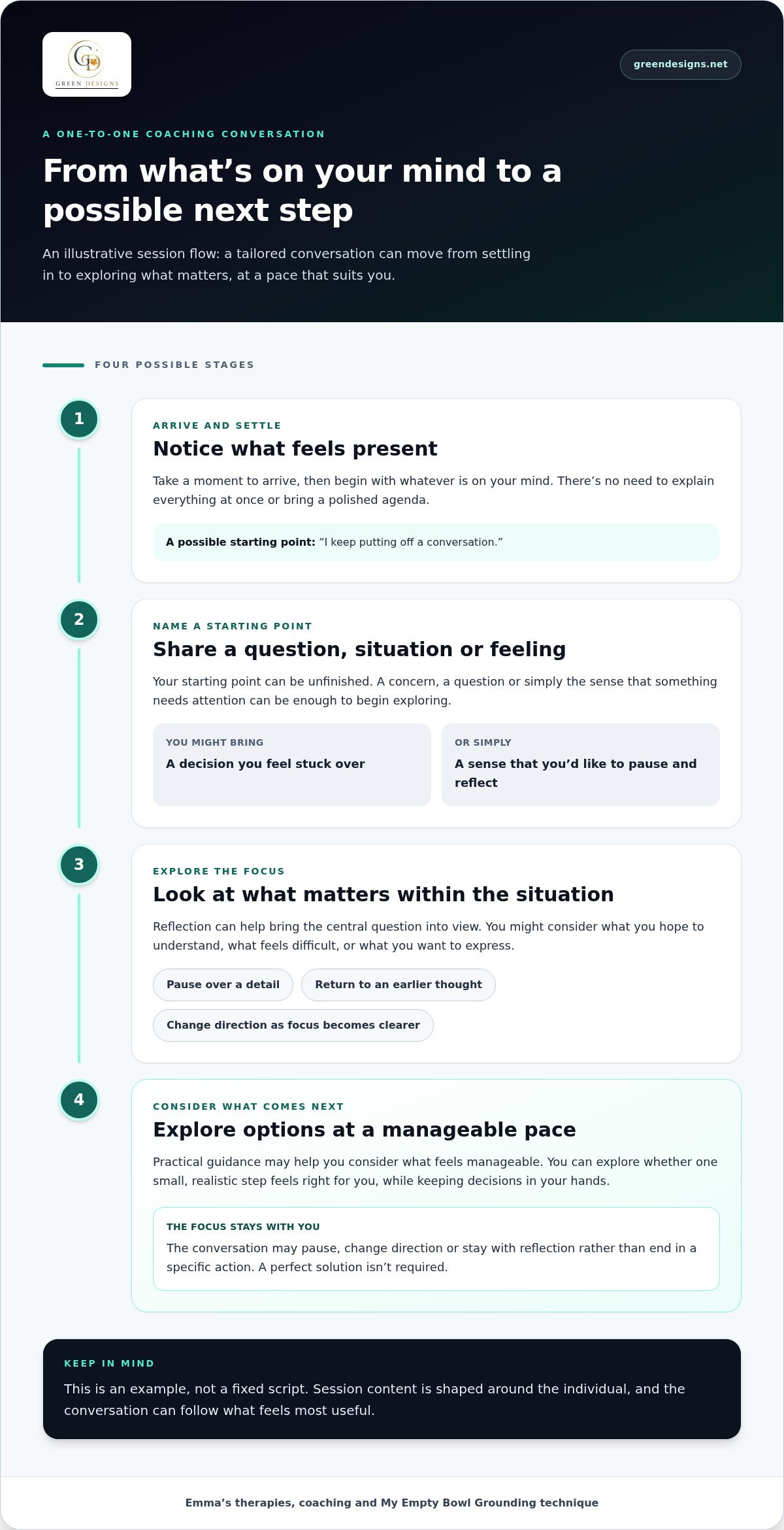
Session content is shaped around the individual. The outline below is an example, not a script or a promise that every conversation follows the same path. The focus can shift as you talk and notice what feels most useful.
Beginning with what is present
The opening can be gentle: take a moment to settle, describe what’s on your mind and begin to find a focus together. You might say, “I keep putting off a conversation,” or “I’m not sure which change to make first.” Those everyday concerns are enough to start exploring. You don’t need to explain everything at once.
From there, the conversation can help bring the central question into view. A concern about a difficult conversation, for instance, might lead you to consider what you want to express or what makes it hard to begin. You can clarify the focus through reflection instead of having to arrive with the perfect words.
Turning reflection into a useful next step
As your thoughts take shape, you may begin to see options that were difficult to spot when everything felt tangled together. A coach can offer practical guidance and help you reflect on what feels manageable, while keeping your priorities at the centre. You can explore a next step together rather than being given a standard instruction that has to suit everyone.
An illustrative sequence might look like this:
- Settle in. Take a moment to arrive and notice what feels present.
- Name a starting point. Share a question, situation or feeling, even if it’s not fully clear yet.
- Explore the focus. Reflect on what matters within the situation and what you’d like to understand.
- Consider what comes next. Look at possible options and whether one small, realistic step feels right for you.
The conversation may pause, change direction or stay with reflection rather than end in a specific action. The aim isn’t to leave with a perfect solution. It may be enough to understand your concern differently or have a clearer sense of what you want to consider next.
If this thoughtful, individual approach feels suited to what you’re looking for, you can explore Emma’s approach to personal support.
How to tell whether individual coaching sessions feel like the right kind of support
It’s understandable to wonder whether coaching will feel too vague. A useful conversation starts with what matters to you, rather than an imposed agenda. Perhaps you want to think through a decision, understand a recurring personal obstacle or give more attention to your emotional wellbeing. Use those priorities to clarify what you’re hoping the support will offer.
Different approaches serve different purposes. Structured advice can offer direction or information; self-reflection gives you space to think independently; tailored coaching creates a supportive conversation around your concerns and aims. None is automatically the right choice for everyone. Consider whether you’re looking for direct guidance, room to reflect or a combination shaped around your circumstances.
What are you hoping to receive from support?
Before deciding, ask yourself whether you’d value a ready-made answer or prefer space to explore the question and consider your options. You may be holding several concerns at once, or feel unsure which one deserves attention first. That uncertainty can be your starting point, not a sign that you need to have everything worked out beforehand.
If you’re looking for clear information
Consider what you need to understand or decide, and whether direct, structured guidance would be most useful.
If you want room to think
Ask whether you’d benefit from quiet reflection, without needing to turn every thought into an immediate action.
If you’re exploring a personal obstacle
Consider whether a conversation shaped around your priorities could help you examine what feels difficult and decide what you’d like to focus on.
If emotional wellbeing is part of your concern
Notice what kind of support feels appropriate to the issue you’re facing and what you hope a conversation might offer.
Use these questions to clarify your hopes, not as a test you need to pass. Individual coaching sessions offer a tailored space to explore personal concerns, though coaching won’t suit every circumstance or guarantee a particular kind of change. If your needs feel uncertain or extend beyond what you want to explore through coaching, learning about different forms of support can help you decide what feels appropriate.
Is tailored support different from a fixed coaching formula?
Tailoring means giving attention to the person in front of you, rather than asking them to fit a universal agenda. Your priorities may change as you reflect. You might hesitate, revise a question or discover that another concern feels more pressing. Those shifts are reasonable and can help clarify what matters, rather than suggesting you’re approaching support incorrectly.
This section offers a starting point, not a full comparison of therapy and coaching. To think about the difference, consider the purpose and style of each approach and how they relate to what you’re seeking. Take your time. Noticing what feels like a good fit is part of the reflection.
How to arrive at an individual coaching session without needing a perfect plan
Preparing for a conversation doesn’t have to mean writing a list, rehearsing what to say or deciding in advance what the answer should be. A little quiet noticing may be enough. If several things have been on your mind, bring that uncertainty with you rather than trying to untangle everything alone first.
A useful starting point can be a question, not a complete plan. You might be wondering why a decision feels difficult, or simply want to make room for something you haven’t had space to consider. Individual coaching sessions can begin with that imperfect first thought. Preparation is optional, not a condition for receiving support.
A gentle way to gather your thoughts beforehand
If it feels helpful, pause briefly before the session and notice what has been taking up space in your mind. You could hold one situation, recurring thought or area of life in view, then ask yourself what would make the conversation feel worthwhile. There’s no need to write anything down unless that feels natural to you.
- Notice what’s present. Is there a decision, interaction or change you keep returning to?
- Listen for what you hope might feel different. Perhaps you’d like more clarity, a chance to say something aloud or simply time to understand your own perspective.
- Let the focus remain open. If another concern comes to mind during the conversation, it’s all right to acknowledge that too.
These prompts are invitations, not homework. You don’t need to arrive with a tidy summary or decide which concern matters most. Even “I’m not sure where to start” can express something real about how you’re feeling. The conversation can begin there.
Making space for reflection after a session
Afterwards, notice which idea stayed with you, whether a possible next step felt manageable or if a question still seems worth considering. There’s no required way to record this. A quiet thought on the way home, a note in your phone or a later moment of reflection can all be enough.
Reflection isn’t a scorecard. You don’t have to measure a session by how much you accomplished or whether you acted on an idea straight away. Perhaps something became clearer; perhaps you’re still sitting with it. Both are observations, not evidence of success or failure. Let your response unfold at its own pace, without expecting a particular result.
If you’d like to learn more about Emma’s therapies, coaching and My Empty Bowl Grounding technique, explore how this grounded approach connects with thoughtful, personal support.
Emma’s therapies, coaching and My Empty Bowl Grounding technique
Personal support can feel more approachable when it makes room for both thoughtful conversation and moments of grounding. Emma’s therapies, coaching and My Empty Bowl Grounding technique bring these elements together, with one-to-one guidance tailored to personal obstacles and emotional wellbeing. The focus is not on fitting your experience into a universal formula, but on making space for what feels meaningful to you.
In individual coaching sessions, practical guidance and supportive mindfulness techniques can sit alongside reflection. You can explore a concern, notice what you need from the conversation and consider what feels manageable, without being hurried towards a particular conclusion. Your perspective remains central, and the pace can leave room for uncertainty as well as clarity.
A personal approach to emotional wellbeing and growth
Emma’s approach recognises that each person brings their own circumstances, questions and hopes. One-to-one support attends to what you’re experiencing and what you’d like to explore, rather than assuming the same conversation will suit everyone. Practical guidance can help you consider possible ways forward, while mindfulness techniques offer a gentle way to pause and notice what’s present.
There’s no need to arrive with a fixed idea of what growth should look like. You may want to understand a personal obstacle, give your emotional wellbeing more attention or simply find room to reflect. The meaning of the conversation belongs to you; it can unfold at a considered, personal pace.
Where the My Empty Bowl Grounding technique fits
My Empty Bowl is a grounding and mindfulness tool created by Green Designs. The My Empty Bowl Grounding technique can sit alongside intentional reflection, offering a way to bring attention back to the present. It is one element of a wider approach to support, not a promise of a particular feeling or outcome.
Grounding and conversation can complement one another simply: reflection gives you space to consider what’s on your mind, while a mindfulness practice can invite a moment of pause. What feels useful will be personal. The technique needn’t define the whole session; the emphasis remains on your concerns, your emotional wellbeing and the kind of support you’re seeking.
If this grounded, individual approach resonates with you, explore support with Emma.
Let your next step begin with curiosity
You don’t have to decide everything about your personal growth before taking a first step. You might simply notice what you’re ready to give attention to, or what kind of conversation would feel meaningful at this point in your life. That quiet curiosity can guide what you explore next.
As you consider individual coaching sessions, let the decision belong to you. There’s no need to rush towards a plan or arrive with certainty. Take a moment to see whether this approach feels in tune with what you’re seeking, and let your questions emerge in their own time.
If you’d like to explore what this support could look like for you, explore Emma’s therapies, coaching and My Empty Bowl Grounding technique. A thoughtful beginning can be small: one pause, one question, one gentle step towards the support that feels right.
Frequently Asked Questions
Can I have individual coaching sessions if I do not know what I want to work on?
Yes, you can begin without a defined goal. You might say that a particular decision keeps returning to mind, or that you’ve felt unsettled without knowing why. From there, the conversation can explore what feels most relevant today. You don’t need to prepare a complete explanation or decide on an outcome before you start; an unclear feeling can still be a meaningful place to begin.
Are individual coaching sessions suitable if I have more than one concern?
Yes, you can bring several concerns into the conversation, particularly if they overlap. For example, a change at work might affect how you feel about time, confidence or relationships. Rather than trying to untangle everything at once, consider which concern feels most present or what you’d most like to understand. The focus can reflect your priorities, without assuming every issue needs to be resolved in one session.
What if I feel emotional during an individual coaching session?
Feeling emotional during personal reflection is nothing to be ashamed of. You can choose what you feel comfortable sharing and say if you’d like a moment to gather your thoughts or move to another subject. For instance, you might explain that a topic feels difficult without going into details. The purpose is supportive reflection and practical guidance, not a promise to remove difficult feelings or make them disappear.
Do I need to prepare notes before an individual coaching session?
No, notes aren’t necessary. If you find writing helpful, keep a brief reminder of a question or situation, such as a decision you’ve been postponing or a conversation you’re unsure how to approach. A few words are enough; you don’t need to create a detailed account. You can also come without notes and speak from whatever feels clearest in the moment.
How many individual coaching sessions will I need?
There isn’t a set number that applies to everyone. The amount of support depends on what you want to explore, what feels useful to you and whether your priorities change over time. You might begin with one concern and later find another deserves attention. Stay curious about what you’re hoping for, rather than treating a fixed number of sessions as a promise of a particular result.
Can individual coaching sessions include mindfulness?
Yes. Emma’s therapies, coaching and My Empty Bowl Grounding technique include supportive mindfulness approaches. My Empty Bowl is a grounding and mindfulness tool created by Green Designs. Mindfulness can be part of a reflective conversation, but it isn’t a guarantee of a particular emotional or therapeutic result. Consider whether this grounded element feels relevant to the kind of support you’re seeking.
Is individual coaching only for people facing a major life change?
No. Someone might seek support during a major transition, but a personal obstacle or a wish to give emotional wellbeing more attention can also be a reason to reflect. For example, you may want to think through a choice before it becomes urgent, or understand what’s making an everyday situation feel difficult. You don’t have to wait until life feels overwhelming to consider what support might suit you.