
If you’re wondering how to find the right therapist, it can help to remember that you don’t have to make a perfect choice on the first try. Opening up to someone new takes trust, and a list of qualifications can’t tell you everything about how a conversation will feel.
You may already know you’d like support but still feel unsure what kind, or how to describe what’s been weighing on you. This practical checklist will help you put your needs into words, consider professional information alongside personal fit, and notice whether you feel heard, respected and able to set boundaries. You don’t need to have everything figured out before taking a first step.
We’ll look at what to reflect on before seeking support, what to notice in an initial conversation, and how to revisit your decision if the fit doesn’t feel right. You’ll also find space to consider Emma’s therapies, coaching and My Empty Bowl Grounding technique as ways to explore personal support and grounding. Go at your own pace; a first conversation can simply be a beginning.
Key Takeaways
- To understand how to find the right therapist, note what feels difficult, what you hope might change and what matters most to you now.
- Different approaches and formats have different aims. Consider what feels comfortable and practical for your circumstances rather than looking for a universally best option.
- When shortlisting, weigh relevant experience, approach, format, boundaries and accessibility. Consider professional membership or registration in relation to the practitioner’s role.
- One first conversation doesn’t have to settle everything. Notice whether you feel listened to, respected and able to speak at your own pace.
- Support should feel personal and allow room for your preferences and pace. Emma’s therapies, coaching and My Empty Bowl Grounding technique offer ways to explore support and mindfulness.
How to find the right therapist starts with what you need
Not knowing where to begin is a common part of seeking support. You don’t need a complete explanation, a diagnosis or the perfect words before taking a first step. A little reflection can help you describe what’s happening and what kind of support might be useful.
Think of this as gathering a few loose threads, not completing a form correctly. Note what feels difficult, what you hope could shift and what matters most to you at this point. Your answers can be brief or uncertain, and they may change as you think them through.
Name what is bringing you to therapy
Start with everyday language. Perhaps you’ve been feeling on edge, stuck in the same argument, drained by work or unsure how to make a decision. Notice when the feeling or pattern tends to arise and how it affects ordinary parts of life, such as sleep, relationships, concentration or making time for yourself.
You could also consider whether something has changed recently or whether this concern has been present for longer. There’s no need to decide what it means. A simple note such as “I feel overwhelmed after difficult conversations” is a useful starting point.
Decide what you hope support could offer
Consider what might feel helpful now. Would you value a quiet space to reflect, practical guidance for a particular challenge, or emotional support as you make sense of a difficult experience? You might want one of these, or a mix that becomes clearer over time. Learning about different kinds of support can help you weigh their aims, while remembering that the right fit is personal.
It can help to separate an immediate concern from a longer-term hope. An immediate concern might be getting through a stressful period; a longer-term hope could be understanding a recurring pattern or feeling more at ease in a relationship. Neither needs to become a fixed promise about what therapy must achieve. Keep your hopes open enough to make room for discovery.
A clear starting point can be a feeling, a concern or a question.
If you’re unsure what kind of practitioner to look for, this overview of types of mental health professionals can help you become familiar with different roles and areas of expertise. You don’t need to settle every question before beginning. For now, keep these three prompts nearby:
- What feels difficult, and when does it tend to show up?
- How is it affecting my day-to-day life?
- What kind of support might feel useful at this stage?
There’s no single right way to answer. A few honest words are enough to begin exploring how to find the right therapist for you.
Match a therapist’s approach and format to your preferences
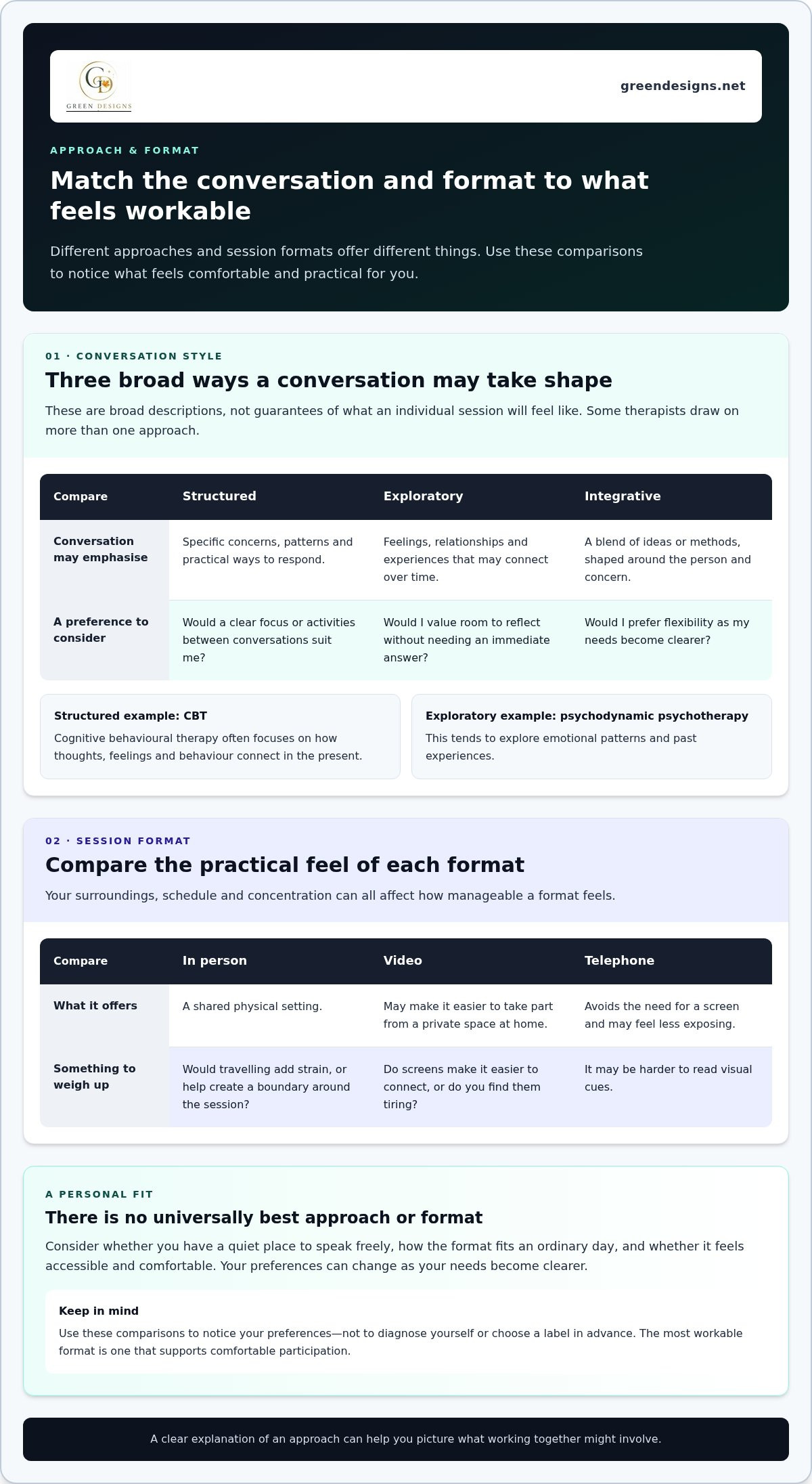
Therapy isn’t one kind of conversation. Some approaches give more attention to present-day thoughts and actions; others make room to explore feelings, relationships and experiences over time. Neither style is automatically better. As you consider how to find the right therapist, think about what helps you feel engaged: a clear structure, space to reflect, or a thoughtful blend of both.
Consider what kind of conversation feels supportive
Cognitive behavioural therapy (CBT), for example, often focuses on how thoughts, feelings and behaviour connect in the present. Psychodynamic psychotherapy tends to explore emotional patterns and past experiences. These are broad descriptions, not guarantees of what any individual session will feel like. Some therapists draw on more than one approach. The American Psychological Association’s overview of the benefits of psychotherapy also describes how approaches can differ.
| Broad approach | What the conversation may emphasise | A preference to consider |
|---|---|---|
| Structured | Specific concerns, patterns and practical ways to respond | Would a clear focus or activities between conversations suit me? |
| Exploratory | Feelings, relationships and experiences that may connect over time | Would I value room to reflect without needing an immediate answer? |
| Integrative | A blend of ideas or methods, shaped around the person and concern | Would I prefer flexibility as my needs become clearer? |
Use the table to notice your preferences, not to diagnose yourself or choose a label in advance. You might value practical focus for one concern and deeper reflection for another. Clear explanations of an approach can help you picture what working together might involve.
Choose a format that feels workable
Session format can shape how easy it feels to settle into a conversation. In-person sessions offer a shared physical setting, while video may make it easier to take part from a private space at home. Telephone sessions avoid the need for a screen and may feel less exposing, although it can be harder to read visual cues. Each format has different practical considerations, and your comfort matters.
Think about your surroundings, schedule and concentration. Is there a quiet place where you can speak freely? Would travelling to an appointment add strain, or help you create a boundary around the session? Do screens make it easier to connect, or do you find them tiring? Consider accessibility too, including whether the format feels manageable on an ordinary day.
The most workable format is one that supports consistent, comfortable participation.
Your preferences don’t have to be set in stone. You may understand more about what helps after trying a particular approach or format, and it’s fine to revisit your choice. Emma’s therapies, coaching and My Empty Bowl Grounding technique offer ways to explore supportive guidance and mindfulness at your own pace.
Use this checklist to shortlist a therapist with confidence
A shortlist can make the search feel more manageable. Rather than comparing every detail, return to a few points that matter for your wellbeing and everyday life. The aim isn’t to find a flawless profile on paper. It’s to identify practitioners whose stated experience, working style and practical arrangements seem relevant to your needs.
- Relevant experience: Look for clear information about the concerns or life experiences the practitioner works with. Consider whether their description connects with what you want support for.
- Approach: Check how they describe their way of working. Does it sound like a style of conversation you could feel comfortable taking part in?
- Format: Consider whether sessions are in person, by video or by telephone, and whether that arrangement would suit your circumstances.
- Boundaries: Look for accessible explanations of confidentiality, the limits of privacy and how the working relationship is held.
- Practical accessibility: Think about online access or travel, scheduling, communication and any needs that could make participation easier or harder.
Review professional information and boundaries
Public profiles can help you understand a practitioner’s stated training, relevant experience and professional background. Where applicable, you can also look for registration or membership with the professional body relevant to their role. Arrangements vary between practitioner types, so the meaning of a title or membership can differ. Clear information helps you understand what is being presented without needing to become an expert in every credential.
Look for an explanation of confidentiality and professional boundaries too. Knowing how privacy is approached and what the working relationship involves can help you feel more prepared to begin a conversation. If a detail matters to your decision, make a note of it so you can discuss it as part of the conversation. Focus on understanding, rather than testing yourself to cover every possible question at once.
Keep the shortlist true to your everyday needs
A profile may appear impressive and still not speak to your priorities. Weigh practical matters alongside professional information: whether the format is accessible, the communication is clear and the stated approach seems compatible with your preferences. You might also consider whether aspects of identity, culture or lived experience matter to your sense of being understood.
Professional credentials can inform your choice, but they can’t guarantee that you’ll feel understood. Personal fit becomes clearer through the way someone listens, explains their work and responds to you. A public description is a starting point, not a promise of connection.
To keep searching manageable, write down your essential criteria and a few preferences you could be flexible about. Then create a short list based on those meaningful points, rather than opening an endless trail of profiles. This gives you a steady way to consider how to find the right therapist without asking a directory or a set of qualifications to make the whole decision for you.
How to recognise whether the first conversation feels right
A first conversation can bring nerves, even when you’ve chosen to seek support. You may be deciding whether to share something personal with someone you’ve only just met, so feeling uncertain doesn’t automatically mean the fit is wrong. Nor does one warm conversation settle the whole decision. Treat it as an opportunity to notice and reflect, rather than a test you have to pass.
Notice how you feel during and after the conversation
As you talk, notice whether the therapist listens without rushing you, responds respectfully and leaves room for you to find your words. Do their explanations make sense? Can you say you’re not ready to discuss something or that you need a moment? You don’t need to feel completely at ease straight away, but you should be able to notice how the conversation is being held.
Afterwards, give yourself a little time before drawing a conclusion. You might feel relieved, thoughtful, tired or still nervous. Rather than treating one feeling as proof, consider what contributed to it. Perhaps the pace felt manageable, or perhaps you felt hurried and unsure what would happen next. A few notes can help you distinguish the unfamiliarity of beginning from discomfort that deserves attention.
It can be useful to discuss how the therapist approaches the concern you’ve raised, what a session might involve, and how confidentiality and boundaries are handled. You can also say, “I’m not sure how to explain this yet,” or “Could we slow down?” The response can help you understand whether you feel respected and able to take part in a way that suits you.
Let fit develop through an open conversation
Suitability can become clearer as conversations unfold. If you continue, you can share what feels helpful, what feels difficult, or whether you’d like to approach something differently. Reviewing what you hope to focus on, and how the working relationship feels, can be an ordinary part of reflective support. You don’t have to wait until you have a perfectly formed concern before speaking up.
It’s all right if the answer takes time. Initial nervousness may ease as you become more familiar with the process, while persistent feelings of being dismissed, pressured or unable to speak freely may point to a mismatch. You can pause, reflect and reconsider. Choosing to change direction isn’t a failure; it’s information about what you need from support.
This is one reason how to find the right therapist isn’t always a single decision made from a profile. It can be an evolving conversation between what you need and what the experience is actually like. If you’re exploring personal support, you can also explore Emma’s therapies, coaching and My Empty Bowl Grounding technique.
Finding support that feels personal: Emma’s approach
The points in this checklist are there to help you listen to your own needs, not to make the choice for you. What feels supportive will depend on your circumstances, preferences and pace. You might want space to reflect, practical guidance, or a grounding practice to weave into daily life. There’s no single route that suits everyone, and it’s all right to take time to sense what feels relevant.
Explore Emma’s therapies and coaching
Emma’s one-to-one therapies and coaching sessions are tailored to the individual, with support shaped around personal obstacles and emotional wellbeing. They offer practical guidance and supportive mindfulness techniques, alongside space for personal growth. You can begin with what feels most present and allow the focus to take shape around your needs, without arriving with a perfectly formed plan.
As you consider this kind of individual support, reflect on what you’d want from the conversation. Would thoughtful guidance help as you work through a challenge? Are mindfulness techniques something you’d like to explore? Perhaps you’re looking for space to make sense of what’s happening without needing to know in advance what the next step should be. These questions can help you decide whether Emma’s therapies and coaching resonate with you. The approach won’t suit everyone, so your own sense of fit matters.
Consider the My Empty Bowl Grounding technique
My Empty Bowl is a mindfulness and contemplation tool developed to support grounding rituals. The My Empty Bowl Grounding technique offers a focus for pausing and giving attention to the present moment. You might use it as a companion to intentional practice, rather than another task to complete or a measure of how well you’re doing.
A grounding tool can sit alongside other forms of support, but it isn’t a substitute for therapy. It may be meaningful to some people and less suited to others; what matters is whether it feels useful and comfortable within your routine. You can remain curious without needing to make a commitment or decide that one practice must meet every need.
Choosing support can be gradual. Take what feels helpful from the process, notice what doesn’t, and return to your decision as your needs become clearer. If you’d like to learn more, explore Emma’s support and My Empty Bowl.
Take your next step at your own pace
You don’t need to solve every question before beginning. One small step may be enough: take time to notice what you’re ready for, and let your understanding grow as you go. Learning how to find the right therapist isn’t about making a perfect choice immediately. It’s about making room for a decision that feels considered and true to you.
If you’d like to explore personal support and grounding, discover Emma’s therapies, coaching and My Empty Bowl Grounding technique. You can read about these options and consider what resonates with your needs today.
Moving slowly still counts as moving forward. Trust yourself to pause, reflect and adjust course as you learn more. Your next step can be a gentle one.
Frequently Asked Questions
Is it normal to feel nervous before speaking to a therapist?
Yes, feeling nervous before speaking to a therapist can be very understandable. Sharing personal experiences with someone new may feel unfamiliar, even when you want support. You can take your time, begin with something manageable, or say that you’re finding it hard to start. Notice whether the therapist responds with patience and care. Nerves alone don’t prove the fit is wrong, and they may not disappear after one session.
Can I see a therapist if I do not have a diagnosis?
Yes, people may seek support without having a formal diagnosis. Difficult feelings, a life change, relationship worries or a wish to reflect can all be reasons to explore a conversation. You could describe what’s been happening in ordinary words, such as “I’ve felt unsettled since changing jobs”. You don’t need to label the experience in advance. An initial discussion can help clarify what kind of support may be appropriate for your circumstances.
How long does it take to find the right therapist?
There’s no set timeframe for finding a therapist who feels suitable. Your preferences, the options available and how comfortable you feel exploring them can all shape the process. To keep it manageable, choose a few criteria that matter most, such as the focus of support and a workable format, then begin with a small shortlist. If you’re wondering how to find the right therapist, remember that a careful choice may take time; speed alone doesn’t make it a better fit.
Is online therapy a good option?
Online sessions can be a workable option for some people, whilst others prefer meeting in person or speaking by telephone. Consider whether you can find a private space, whether your internet connection and device feel reliable, and whether looking at a screen helps or distracts you. For example, a quiet room may make video easier, while a phone call might suit someone who finds screens tiring. No format is best for everyone; your circumstances and comfort matter.
Will a therapist tell me exactly what to do?
Not necessarily. Therapy isn’t always about receiving instructions or having someone decide on your behalf. Depending on the approach, conversations may help you explore an experience, notice a recurring pattern or consider a practical next step. If you value a clear structure, you can say so; if you’d rather have room to reflect, you can explain that too. Sharing your expectations can help shape a way of working that feels useful to you.
What should I do if I need urgent mental health help?
This therapist-finding checklist isn’t a crisis service. If you or someone else is in immediate danger, call 999 or go to A&E now. For urgent help that isn’t an immediate emergency, contact NHS 111 or the relevant NHS urgent mental health service where you live. Routes and services can differ across the UK. Please seek urgent help directly rather than waiting for a therapy appointment.