
What if your first therapy session didn’t require you to know exactly what to say? If you’re wondering what to expect from therapy, it’s natural to feel unsure about what the conversation might cover or how much of your story you’ll need to share. You don’t need a prepared script, a clear diagnosis or an immediate answer before you begin.
Therapy is a conversation, not a test to pass. A first session may include questions about what’s been on your mind, what you’d like support with and what you hope might feel different. You can share at your own pace. It’s all right to say that something feels difficult to talk about or that you’re not sure where to start.
In this guide, we’ll look at how an initial session may unfold, how the focus and feelings can vary from person to person, and what practical support, such as mindfulness techniques, might involve. Green Designs’ one-to-one therapy and coaching is tailored to the individual, making room to begin with curiosity and take things gently, one conversation at a time.
Key Takeaways
- Understand what to expect from therapy, from the opening conversation to the questions that may help shape your support.
- Learn how to share personal experiences at a manageable pace, without feeling obliged to tell everything at once.
- Explore why progress can look different for each person and may not follow a straight line.
- Find reassurance about emotions, pauses and uncertainty that may arise during sessions.
- See how Green Designs’ one-to-one therapy is tailored around personal obstacles and emotional wellbeing.
Therapy: A Space to Begin Without Having All the Answers
Looking for therapy can bring relief, uncertainty or both. You might feel ready to talk and still wonder where to begin. There’s no single experience to prepare for: the conversation and its focus can vary according to the person, their circumstances and the support they’re seeking.
Therapy is a supportive conversation that offers space to explore feelings, experiences and patterns with care.
You might explore how a past experience still affects you, or reflect on a pattern that keeps appearing in relationships or daily life. The word therapy covers a range of approaches and aims; the Psychotherapy overview provides broader context. In your sessions, the focus is on what feels relevant to you.
Some people arrive with a specific difficulty to discuss. Others have a wider sense that something feels unsettled, or want to understand themselves better. You don’t need a polished explanation before beginning. Describing what you’ve noticed, even if it feels incomplete, can be enough to start.
Do I need a clear reason to start therapy?
No. Uncertainty can be a useful place to begin. You might say that you feel stuck or overwhelmed, or that you’re unsure why the same situations keep troubling you. There’s no need to diagnose yourself or find the perfect words first. Start with what you’ve noticed, then take time to make sense of it together.
Is therapy a conversation or a set of techniques?
Conversation is often central, but sessions can take different forms. Some may involve reflection and questions; practical activities or mindfulness techniques may also support the work. These aren’t required in every session, and therapy doesn’t follow one universal script. The focus can develop around what feels useful to explore.
What happens in a first therapy session? A gentle step-by-step guide
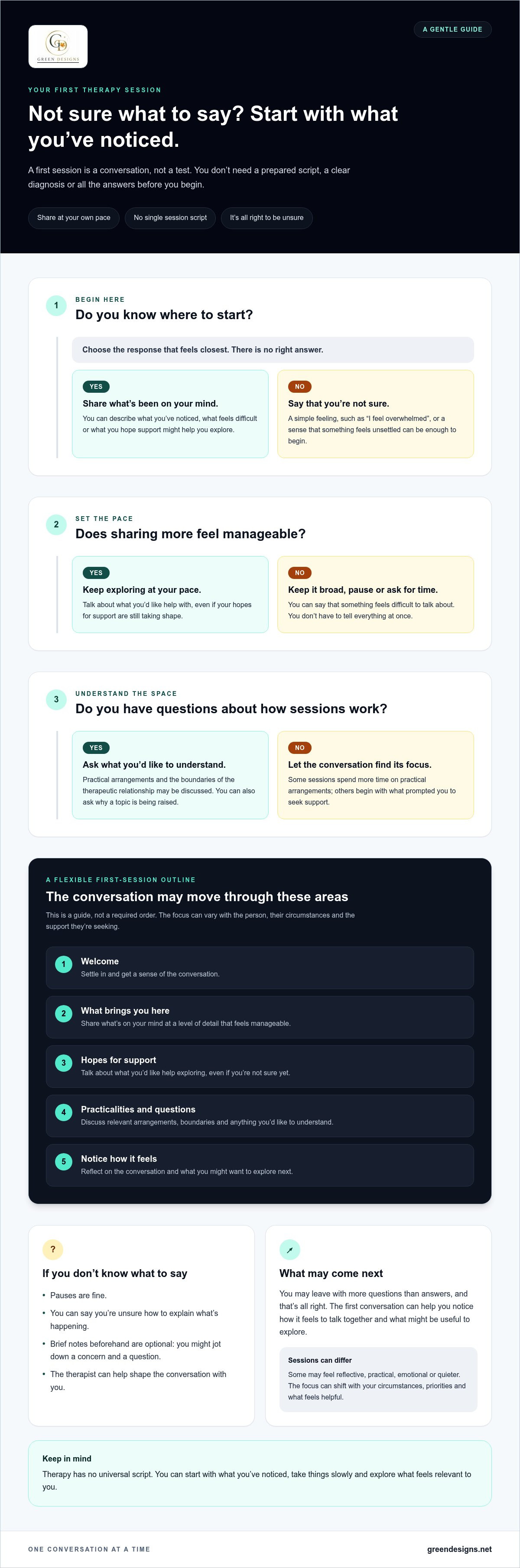
A first session is often a chance to meet, settle in and find a starting point for the conversation. It isn’t an assessment you need to pass, and there’s no single script that every therapist follows. If you’re wondering what to expect from therapy, this outline can help you picture how an opening session might unfold, while leaving room for your experience to be different.
A general guide to a first therapy session
- Welcome: Settle in and get a sense of the conversation.
- What brings you here: Share what’s been on your mind at a level of detail that feels manageable.
- Hopes for support: Talk about what you’d like help exploring, even if you’re not sure yet.
- Practicalities and questions: Discuss relevant arrangements, boundaries and anything you’d like to understand.
- Notice how it feels: Reflect on the conversation and what you might want to explore next.
This is a flexible outline, not a required order. Some sessions may spend more time on practical arrangements; others may begin with what prompted you to seek support. Getting started can include discussing how sessions work and the boundaries of the therapeutic relationship. These details help you understand the space you’re entering.
What might a therapist ask me?
A therapist may ask what feels difficult at the moment, when you first noticed it, or what you hope support might offer. These questions help build context, not test you for the right answer. You can keep your response broad, ask why something is being discussed, or say that a question feels difficult and you need time.
What if I do not know what to say?
Pauses are fine. You could begin with a simple feeling, such as “I feel overwhelmed”, or say you’re not sure how to explain what’s happening. If it helps, jot down a few brief notes beforehand: a concern you’ve noticed and a question you’d like to ask. Preparation is optional; the therapist can help shape the conversation with you.
The first session is also a chance to notice how it feels to talk together. You may leave with more questions than answers, and that’s all right. Green Designs’ one-to-one therapy is tailored to personal obstacles and emotional wellbeing, offering a supportive setting to explore what matters to you. You can explore one-to-one therapy at your own pace.
How therapy sessions may develop, and what progress can look like
As therapy continues, the conversation may return to themes that have surfaced before, make room for something new, or turn to a concern that feels pressing now. Revisiting an issue doesn’t mean you’re going backwards. A familiar subject can look different when you’ve had space to notice more about it.
There’s no universal pattern for ongoing sessions. Their focus can shift with your circumstances, priorities and what feels helpful to explore. You and your therapist can reflect on how the work is going and adjust its direction together. The process may change as you do.
Will every therapy session feel the same?
No. One session may feel reflective, another more practical or emotional, and some may be quieter. A new challenge or a thought that has stayed with you since the previous conversation might shift the focus. There’s no single structure that fits every approach or person.
You don’t need to arrive with a fresh revelation each time. A quieter conversation can still give you room to pause and notice what’s present. If your needs or priorities have changed, bring that into the discussion rather than feeling you have to stick with a topic that no longer feels central.
How can I recognise progress in therapy?
Progress doesn’t always feel like a sudden change. It may show up in small moments: noticing a familiar pattern sooner, finding words for a need, or responding to a difficult situation in a more considered way. What feels meaningful will depend on your life and what you hoped to explore.
Progress doesn’t mean feeling better after every session. A conversation may bring up complicated feelings or leave you with something to reflect on. That alone doesn’t tell you whether therapy is useful. Give yourself room to notice what the experience is like without expecting every meeting to provide a clear answer.
If you’re unsure whether anything is changing, or you feel stuck, that can become part of the conversation. Describe what you’ve noticed, what feels hard to shift or what you’d like to approach differently. Reflecting together can help you consider whether the focus still fits or could be adjusted. The pace needn’t be perfect or predictable; it can be shaped collaboratively, one conversation at a time.
Common worries about therapy: privacy, difficult feelings and taking things slowly
Questions about privacy, strong emotions or how much to share can make starting therapy feel daunting. You might worry that beginning means telling your whole story straight away. It doesn’t. You can choose what to talk about, leave some details for another time, or explain that you’re not ready to discuss something yet.
You can tell your therapist what feels comfortable and ask to take the conversation at a pace that works for you.
Is it normal to feel nervous or emotional in therapy?
Feeling nervous is understandable, though not everyone experiences therapy in the same way. Talking about something important may bring emotion; at other times, you might feel calm, uncertain or quiet. There’s no expected response. If a subject begins to feel like too much, you can say so, ask to pause or turn to something else for a while.
Silence can be part of a conversation too. You don’t have to fill every pause or explain exactly why you need a moment. Letting your therapist know that you feel unsettled, or are worried about becoming emotional, gives the conversation a chance to respond to what you need.
What can I share about confidentiality and personal boundaries?
Privacy arrangements, including any limits to confidentiality, should be explained as you begin. Details can depend on the service and circumstances, so listen to the explanation rather than assume the same arrangements apply everywhere. If a phrase is unclear, ask what it means or how it relates to what you may share.
You can also talk about personal boundaries: what you feel ready to discuss, what you’d prefer to leave for later, and what would help you feel more at ease. You aren’t required to disclose everything in one conversation. Sharing gradually can give you space to notice what feels manageable as trust develops.
If you’re considering what to expect from therapy, remember that you can raise concerns about privacy, emotion or pace directly. These aren’t interruptions to the work; they’re relevant to how the conversation feels for you. A pause, a question or a change of subject can help make room for your needs.
If an individual approach feels helpful, you can explore one-to-one therapy and coaching with Green Designs, tailored to personal obstacles and emotional wellbeing.
Beginning therapy with Green Designs: a supportive, individual approach
You don’t need to arrive with a complete explanation of what’s troubling you. A starting point might be a particular obstacle, a feeling that’s difficult to name, or a wish to understand yourself better. It’s enough to begin with what feels present, even if the words come slowly.
Green Designs offers one-to-one therapy tailored to personal obstacles and emotional wellbeing. The individual focus leaves room for the conversation to centre on what matters to you, rather than follow a set script. You can bring a specific concern, take time to explore a broader feeling, or let the focus emerge as you talk.
What a tailored therapeutic conversation can make room for
The conversation can begin with your experiences and concerns, then develop around what feels relevant. Supportive therapeutic guidance may help you reflect on what you’re noticing and consider what you’d like to explore. Practical mindfulness techniques may also be introduced when they suit your needs. They’re one possible element, not something to expect in every conversation.
There’s no need to work out in advance what the “right” topic is. What feels important may become clearer as you speak, or your priorities may shift over time. A tailored approach can make room for that, meeting you where you are rather than asking you to fit a predetermined pattern. Green Designs’ My Empty Bowl is also a mindfulness and contemplation tool designed to support grounding daily rituals.
A gentle next step when you feel ready
Reading about what to expect from therapy can make the idea feel more familiar, but you don’t have to resolve every uncertainty before you begin. Curiosity can be a starting point. So can not knowing quite what you need, while feeling open to a conversation about it.
Green Designs’ one-to-one therapy and coaching offers space for supportive guidance shaped around personal obstacles and emotional wellbeing. There’s no need to arrive with a perfect account or a clear plan. If exploring individual support feels like a gentle next step, read about one-to-one therapy and coaching at your own pace.
Take your first step at your own pace
Knowing what to expect from therapy can make beginning feel a little less uncertain, but you don’t need every question answered before you start. The first conversation may explore what’s brought you there, what support might mean and what you feel ready to share. You can take your time, ask questions and let the focus unfold.
As sessions continue, their shape and your sense of progress may change. Some conversations may feel reflective, others quieter or more practical. There’s no requirement to leave every session feeling better, and doubts or difficult moments can be part of what you discuss together.
At Green Designs, one-to-one sessions are tailored to personal obstacles and emotional wellbeing. Supportive guidance and practical mindfulness techniques may be part of the work when they feel relevant to you. If you’d like to explore individual support, explore one-to-one support with Green Designs.
Frequently Asked Questions
What should I expect at my first therapy session?
A first therapy session often gives you and the therapist space to talk about what has brought you there, what you hope for and any questions you have. You may also discuss practical arrangements. The conversation can take its time. You don’t need to tell your whole story at once, have a clear plan or know exactly how to explain what’s on your mind.
Do I need to prepare before going to therapy?
No, preparation is optional. You could jot down a few thoughts, questions or situations you’d like to mention, such as something that’s been troubling you or what you hope to understand. It’s also fine to arrive unsure where to begin. A therapist can help find a starting point through conversation. You can speak in your own words, pause or say something feels difficult to explain.
Is it normal to feel nervous before therapy?
Yes, feeling nervous is understandable, especially when meeting someone new to talk about personal experiences. You might also feel relief, uncertainty or several things at once. You don’t have to hide those feelings or arrive feeling calm. Saying, “I’m nervous and not sure where to start,” can be a gentle way to open the conversation and help the therapist understand how you’re feeling.
Can I choose what I talk about in therapy?
Yes, you can share at a pace that feels manageable and say when you’d rather pause or move to another subject. Therapy doesn’t require you to disclose everything immediately. Talking about your comfort and boundaries can help shape the sessions around what feels useful and appropriate for you. If a topic feels too difficult today, you can explain that and consider returning to it another time.
How long does therapy take to work?
There’s no single timeframe that applies to everyone. The pace and focus can depend on your circumstances, what you hope to explore and the support you’re receiving. Changes may be subtle, and progress isn’t always linear. Rather than expecting a particular result by a set point, you can talk with your therapist about how the work feels and whether its focus still fits your needs.
Is everything I say in therapy confidential?
Privacy arrangements and any limits should be explained as you begin, and details can depend on the service and circumstances. Confidentiality shouldn’t be assumed to be absolute. If you’re unsure what an arrangement means, ask the therapist to clarify it before sharing information you feel hesitant about. A clear conversation can help you understand the boundaries and make an informed choice about what you’re ready to discuss.
What if I do not feel comfortable during a therapy session?
You can tell the therapist if something feels uncomfortable, confusing or too fast. You might ask for a pause, explain what you need or leave a subject for another time. A helpful therapeutic conversation should make room for feedback, not require you to stay silent. If you’re unsure how to express it, you could simply say, “I’m not comfortable with this yet,” and take it from there.