
What if the best support isn’t the one with the most reassuring label, but the one that meets you where you are? When you’re weighing up therapy or coaching, comparison can feel difficult, especially when practitioners use the terms in different ways. You might want space to understand what’s weighing on you, practical help to make a change, or a little of both. It’s understandable to wonder whether one choice could leave you feeling stuck or out of place.
This guide explains the different aims and boundaries of therapy and coaching, where they may overlap, and what each could offer. You’ll find questions to help you reflect on what you need now, without trying to diagnose yourself or make a perfect decision. Emma offers tailored one-to-one therapies and coaching sessions, with supportive guidance, mindfulness techniques and My Empty Bowl Grounding technique for emotional wellbeing and personal growth. A next step can begin with noticing what you hope might feel different.
Key Takeaways
- Use this therapy or coaching comparison to consider what you’re looking for: space to explore emotional experiences, support with a goal, or a blend of both.
- Learn how therapy and coaching can differ in focus, process and boundaries, while recognising that these are broad patterns rather than fixed rules.
- Understand why coaching isn’t automatically a replacement for therapy, and why the right fit depends on your needs and the practitioner’s scope.
- Try a simple reflection: name what feels difficult, then consider what kind of support might help you move forward.
- Discover how Emma tailors one-to-one therapies and coaching, with practical guidance, mindfulness techniques and My Empty Bowl Grounding technique for emotional wellbeing and personal growth.
Therapy or coaching: what is the difference in purpose?
If you’re unsure which kind of support fits, you’re not alone. The words therapy and coaching can overlap in everyday conversation, and practitioners may describe their work in different ways. The label is only one part of the decision. Consider whether you want to understand feelings or recurring difficulties, work towards a goal, or make space for both.
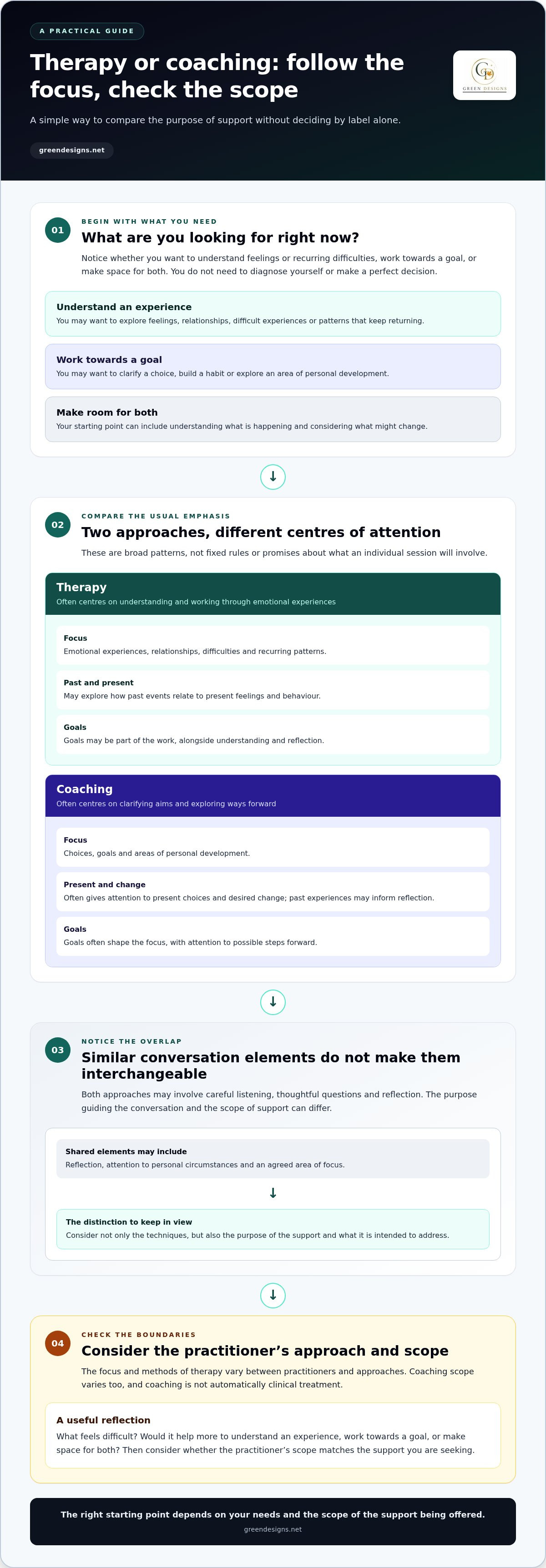
Therapy broadly offers space to explore emotional experiences, relationships, difficulties and patterns, including how past events may affect the present. Coaching is generally structured around reflection, choices and goals, helping someone consider what they want to change or develop. These are broad descriptions, not promises about what every session will involve.
Therapy often centres on understanding and working through emotional experiences; coaching often centres on clarifying aims and exploring ways forward. This is a useful starting point for a therapy or coaching comparison, not a fixed dividing line. Both may involve thoughtful conversation, reflection and attention to personal circumstances.
What does therapy usually help someone explore?
Therapy can provide room to make sense of feelings, relationships, difficult experiences or patterns that keep returning. For example, you might want to understand why a particular situation brings up strong emotions, or explore how past experiences shape how you relate to people now.
You don’t have to be in crisis or have a particular diagnosis to consider therapy. Its focus and methods vary between practitioners and therapeutic approaches, so the experience may look different from one person to another. It can offer time and space to notice what’s happening within you.
What does coaching usually help someone work towards?
Coaching may help you reflect on a personal goal, weigh up a choice, build a habit or explore an area of personal development. If you’re considering a change but feel unsure where to begin, a coaching conversation might help you clarify what matters, identify options and choose a possible next step.
Coaching isn’t automatically clinical treatment, and it shouldn’t be assumed to address every emotional or mental health need. Its shape can vary, too. Goals and forward movement are common themes, but reflection may also involve looking at what has influenced your choices. For background on the practice, Life coaching on Wikipedia offers an overview of life coaching and how it is commonly distinguished from therapy.
There’s no need to decide by label alone. Notice whether you’re seeking understanding, support with a goal, or a blend of the two. That is a practical place to begin.
Therapy vs coaching: compare the focus, process, and boundaries
A side-by-side view can bring the differences into focus, though real conversations are rarely as tidy as a table. Both approaches may involve careful listening, questions and reflection. What tends to change is the purpose guiding the conversation and the scope of support being offered.
| Aspect | Therapy | Coaching |
|---|---|---|
| Typical focus | Exploring emotional experiences, difficulties and patterns. | Clarifying choices, goals and areas of personal development. |
| Role of goals | Goals may be part of the work, alongside understanding and reflection. | Goals often help shape the focus, with attention to possible steps forward. |
| Past and present | May explore how past experiences relate to present feelings and behaviour. | Often gives attention to present choices and desired change, while past experiences may inform reflection. |
| Boundaries | Approach and scope depend on the practitioner and therapeutic method. | Scope depends on the coaching approach; coaching is not automatically clinical treatment. |
These are broad patterns, not strict rules or guarantees about what an individual session will involve. A therapist may help you set a present-day goal or consider practical strategies. A coach may make room for emotions as you reflect on a decision, without that conversation becoming therapy.
How do therapy and coaching differ in focus?
Imagine feeling unsettled by a change in a relationship. Therapy might offer space to explore the feelings and experiences connected with it. Coaching might help you consider what you want to do next and which steps feel possible. Either may involve reflection and practical thought; the emphasis depends on the work and your needs.
Where can therapy and coaching overlap?
Both may include attentive listening, thoughtful questions and an agreed area of focus. You might reflect on what matters to you, notice a recurring response or consider a practical next step. The practitioner’s approach and scope shape how these shared elements are used.
Overlap can make the conversations feel similar, but it doesn’t make therapy and coaching interchangeable. In a therapy or coaching comparison, consider not only the techniques but also the purpose of the support and what it is intended to address.
If you’re considering one-to-one support for emotional wellbeing or personal growth, explore Emma’s therapies, coaching and My Empty Bowl Grounding technique, with sessions tailored to individual needs.
Can coaching replace therapy? Understand the limits before deciding
Coaching isn’t automatically a replacement for therapy. The two may share elements, but their purpose and scope can differ. What feels suitable depends on what you’re experiencing, the support you’re hoping for and what the practitioner’s work is intended to address. A therapy or coaching comparison can offer useful pointers, but it can’t assess your individual circumstances or determine which approach you need.
You don’t have to diagnose yourself before seeking support. Instead, notice whether your concern feels persistent, difficult to manage alone, connected to painful experiences, or centred on a change you’d like to make. These observations can help you describe what’s going on without deciding in advance what it means.
When might someone consider therapy rather than coaching?
If distress has been lingering, affecting daily life, or feels linked to difficult experiences or recurring emotional patterns, therapy may be a helpful option to explore. This is general information, not a clinical assessment. Seeking therapy doesn’t require being in crisis or having a particular diagnosis.
If you or someone else is in immediate danger, call 999 or go to A&E. For urgent mental health support that isn’t an emergency, use the appropriate NHS or urgent-care route for your part of the UK.
When might coaching feel like a useful fit?
Coaching may suit someone who wants space to clarify a goal, weigh up a choice or reflect on personal growth. For example, you might be considering a new direction and want help thinking through what matters and what a manageable next step could be. Coaching can support that reflection, but it can’t promise a particular result or timeframe.
It’s also all right to pause and reconsider. If the conversations don’t feel suited to what you need, take stock of what’s missing and whether a different kind of support may be more appropriate. You can revisit the decision as your circumstances become clearer.
Sometimes a person’s needs shift, or they’re looking for both space to understand an experience and practical support with change. The label alone can’t settle that question. Describe what feels difficult and what you hope support might make room for, then consider whether the practitioner’s scope fits that need.
How to decide between therapy and coaching for your needs
You don’t need to settle the question perfectly before taking a first step. Try a simple sequence: name what feels difficult, consider what kind of support might help, then give yourself time to reflect. This turns a broad therapy or coaching comparison into a more personal question: what would feel useful for you now?
What do you hope will feel different?
Begin with ordinary words, not a label or diagnosis. You might write, “I feel tense when I think about work,” “I’m finding a change hard to process,” or “I want to make a decision but keep going round in circles.” There’s no need to make the description sound polished.
Then notice what you’re hoping for. Would you value space to understand an experience, emotional support as you sit with it, help making a practical change, or some combination? You can keep these questions private and return to them when you feel ready. There’s no single correct answer.
- Understanding: Do you want to explore what may be shaping your feelings or responses?
- Direction: Are you hoping to clarify a choice or move towards a goal you’ve already identified?
- A blend: Would it help to reflect and consider practical next steps at the same time?
What kind of support feels comfortable and useful?
Picture the kind of conversation that might help. Perhaps you’d like room to speak freely and make sense of what’s going on. Or perhaps you’d prefer a clearer focus, with time to consider possible actions towards an aim. Your needs may not fit neatly into either description, and that’s all right.
As you consider support, notice the pace and whether the approach feels respectful. Do you feel listened to? Is there room to say what you’re not ready to discuss, or to explain that you need a different kind of conversation? Feeling comfortable doesn’t mean every moment will feel easy, but you should be able to reflect on whether the work feels appropriate to your needs.
You can review the fit over time. What you need may shift as circumstances change, and an early preference doesn’t have to become a permanent decision. If you’re looking for thoughtful, tailored support for emotional wellbeing or personal growth, explore Emma’s therapies, coaching and My Empty Bowl Grounding technique.
Finding tailored therapies, coaching and My Empty Bowl Grounding technique with Emma
Understanding the difference between therapy and coaching can help you name what you’re looking for, but your needs are personal and may not fit a simple category. Emma offers tailored one-to-one therapies and coaching for emotional wellbeing and personal growth, with support shaped around the individual and My Empty Bowl Grounding technique. If this therapy or coaching comparison has left you between wanting to understand what’s happening and hoping to make a change, that uncertainty can be part of the conversation too.
There’s no single formula for personal growth. The focus can begin with what feels most present for you, then take shape around the kind of support that feels relevant. Emma supports clients across the UK with supportive guidance, practical mindfulness techniques and My Empty Bowl Grounding technique as part of her approach.
What can tailored one-to-one support make room for?
One-to-one support can offer room to reflect on personal obstacles, emotional wellbeing and the changes you’re considering. You might arrive with a clear question, or simply a sense that something feels difficult and you’d like time to explore it. Either way, the conversation can be grounded in your experiences and hopes, rather than a universal checklist of what you should be working towards.
Mindfulness techniques may offer practical ways to pause, notice what’s happening and feel more present. Their place depends on the wider support you’re engaging with and what feels useful to you.
A gentle next step when you are ready
After reading this comparison, take a quiet moment to revisit your hopes and questions. What would you like support to make room for? What kind of conversation might feel respectful and helpful? You don’t need a polished answer. A few honest words can be enough to begin describing what matters to you.
Choosing support isn’t a test, and you can take the time you need to consider what fits. If you’d like tailored one-to-one support for emotional wellbeing or personal growth, explore Emma’s therapies, coaching and My Empty Bowl Grounding technique.
Take a gentle next step towards the support you need
A therapy or coaching comparison can help clarify the usual differences, but your own needs matter more than the label. Therapy may offer space to explore emotional experiences and recurring patterns, while coaching can support reflection on goals and possible change. There can be overlap, yet neither approach is automatically a substitute for the other.
You don’t need to have everything worked out before seeking support. Start by noticing what feels difficult and whether you’re hoping for understanding, practical direction, or a little of both. Your needs may shift, and it’s all right to revisit what feels suitable along the way.
Emma offers tailored one-to-one therapies and coaching for emotional wellbeing and personal growth, with supportive guidance, mindfulness techniques and My Empty Bowl Grounding technique. Sessions are available to clients across the UK. To explore this support, read about Emma’s therapies, coaching and My Empty Bowl Grounding technique.
There’s no need to rush your decision. One thoughtful step, taken at your own pace, is enough to begin.
Frequently Asked Questions
Is therapy better than coaching?
Neither is universally better; what feels useful depends on you and your circumstances. Therapy may offer room to explore emotional experiences and recurring patterns, while coaching may help clarify goals and choices. A therapy or coaching comparison can help you understand these usual differences, but overlap is possible, and the distinction is a starting point rather than a ranking. This article can’t assess your needs or determine which approach is right for you.
Can coaching replace therapy?
Coaching isn’t automatically a replacement for therapy. It may support goals, decisions and personal development, while therapy can offer space to explore emotional experiences and difficulties. Each practitioner’s approach and scope matter. If you’re experiencing significant distress or have concerns about safety, don’t rely on a general comparison to decide what help you need. Seek appropriate clinical support; if you or someone else is in immediate danger, call 999 or go to A&E.
What is the main difference between a therapist and a coach?
The broad difference is often the focus: therapy may explore emotions, experiences and recurring patterns, while coaching may help you reflect on goals and possible next steps. These aren’t fixed rules. Both can involve listening and reflection, and approaches vary between practitioners. The label alone won’t tell you exactly what a session will feel like or whether it suits your circumstances, so consider the purpose and scope of the support too.
Can therapy and coaching be used together?
They may address different needs at different times, but combining therapy and coaching isn’t right for everyone. Whether it’s suitable depends on your circumstances and the scope of each practitioner’s work. You don’t need to assume you need both, or that one can stand in for the other. Start by clarifying what you hope to understand or change. If your wellbeing needs feel complex, seek appropriate professional guidance to help you consider suitable support.
How do I know whether I need therapy or coaching?
You don’t need to diagnose yourself before considering support. Ask what you hope might change: would you like room to understand an emotional experience, help clarifying a goal, or both? These reflections can guide your thinking, but they can’t determine a clinical need. If distress feels severe or urgent, seek appropriate professional support rather than relying on a comparison alone. It’s all right if your answer isn’t clear straight away.
Is coaching suitable for emotional wellbeing?
Coaching may support reflection, personal growth and goals connected with emotional wellbeing, depending on its approach and scope. It shouldn’t be treated as a universal treatment or a substitute for clinical care. Emma offers tailored one-to-one therapies and coaching for emotional wellbeing and personal growth, with supportive guidance, mindfulness techniques and My Empty Bowl Grounding technique. If you’re uncertain what kind of help fits, take time to describe what you’re experiencing and consider suitable support without pressure.
What should I expect from therapy or coaching?
Both may involve conversation, reflection and attention to what matters to you, although focus and structure can differ. Therapy may explore emotional experiences and patterns; coaching may centre on goals or choices. There isn’t one format that applies everywhere, and an individual experience depends on the approach and circumstances. A general comparison can help you orient yourself, but it can’t predict exactly what your own sessions would involve.
Can I choose therapy or coaching if I am not in crisis?
Yes. You don’t have to wait for a crisis to consider support. People may explore therapy or coaching for emotional wellbeing, personal reflection or growth. A helpful starting point is to notice what you hope to understand or move towards, without judging whether it seems serious enough. If immediate safety concerns arise, seek urgent help rather than waiting for a routine appointment. Otherwise, you can take time to consider what feels appropriate.